Blog Feed

American Psycho: The Body, Psychosis, and Monstrosity

“Is evil something you are? Or is it something you do?”

In the year of 1991, when American Psycho had first been published, the novel underwent a siege of censorship; both from prospective publishers and reactionary criticism denouncing the work as ‘dangerous’ (Hill, 100). One article professed it: ‘a contemptible piece of pornography, the literary equivalent of a snuff flick […] a bloodbath serving no purpose save that of morbidity, titillation and sensation’ (Yardley, “‘American Psycho’”). What is most intriguing about many of the contemporary reviews from the time, is how consistent the moralising tendency of reviews were revealed to be. Wilde’s The Picture of Dorian Gray, published a century before Ellis’ work, was similarly critiqued for the seeming moral ambivalence of its characters and, as extension of this, its author. Recent criticism has since evolved to see Bateman’s monstrosity as symbiotic to the growing obsession of possessive ownership, born ‘out of the commodified materials of consumer culture’ having been ‘written in the wake of the 1987 stock market crash’ (Kilbourn, 181: De Boever, 51). However, this setting does not provide conclusive reasoning for the extremity of Bateman’s condition. It instead acts as a catalyst, which Ellis uses to materialise the protagonist’s unquestioned debauchery. This essay will demonstrate how psychosis in American Psycho is symptomatic of biological and inherited monstrosity. This is intensified, but not conceived, by monotonous consumer culture.

In a recent interview with ReasonTV, Ellis reflects on the attention the novel has received from its inception in the nineties and leading up to the present day. Ellis notes that ‘there’s something about this book and this character that has kept resonating’, despite professing it to be ‘a strange, personal, [and] experimental novel’ (“on ‘American Psycho’”, 48:56-49.09). The trope of psycho-duality prevalent in Gothic literature is capitalised upon by Ellis, who surmises that art, and in turn American Psycho, ‘takes on a life of its own’, beyond the will of its creator (Ibid, 52:42-45). The consequence of fictitious creation is alluded to here as being synonymous with monstrous autonomy. In Stevenson’s 1886 foundational novella on hidden lives, Strange Case of Doctor Jekyll and Mr Hyde also details this innate, human potential for the murderous. Stevenson’s contribution to this inherited Gothic tradition being the novella’s combination of suspense and ominous uncertainty; moving the location of fear from the isolated castle to the centre of human empire. The Gothic monster is therefore also shifted, both temporally and psychologically, from the fringes of society and into its heart. By the 1990s, the case of American Psycho exhibits this shift in perceptions of monstrosity and the self. The monstrous self is not merely among us; but within us. Ellis’ postmodern take on the urban city unfolds as a series of disorientating occurrences from the insidious entrance of ‘Abandon all hope ye who enter here […] scrawled in blood red lettering’ on a building wall (3). He highlights not only the monotony of the consumer lifestyle through Bateman’s ritualistic ‘morning’ routine, but also the fragmentation of the external monstrous self, replaced by internal psychosis (23). The narrative ‘I’, and eye of the mind, pulls the attention away from the outside world, and into the horrific realm of psychological uncertainty which Serpell characterises as intentional ‘vacuity’ (204). The novel likewise reflects this constant ambiguity as a structural monster of its own making; a Frankenstein hybrid of genres encapsulated by the moving between of television snippets from the Patty Winters Show, the first-person narration of Bateman’s psychosis, and the strange interjections of music criticism. This rupture between narratives disavows engagement with any one perspective, intensified by the novel’s increasingly shorter chapters as symptomatic of the protagonist’s own degeneracy.

Internal monstrosity has traditionally, in teratological history, been viewed as reflecting the external presentation of monstrous biology. ‘Monstrosity’, in etymological terms, is characterised by ‘an instance of abnormal development’ meant to warn of the moral deterioration such a physical deformity signifies (OED). As Carroll states, the monster’s ‘threat is compounded with revulsion, nausea, and disgust’ (22). The body is simultaneously an object of ‘revulsion’ and a seat of moral questioning- as exemplified in the unnatural cadaverous form of Frankenstein’s monster in Shelley’s 1818 novel. However, monstrosity in the postmodern world may no longer be received in terms of physical disgust, but rather, as consequential to conversations of psychoanalysis, we see the emergence of ‘human monsters’ (Morgan, 40). Bateman encompasses the opposite of a repulsive form; the creation of a mimetic effort to ‘fit in’ with the world everyone else inhabits (228). From the novel’s inception every person’s body is the site of physical and metaphysical branding: ‘Zegna’, ‘Bahar’, ‘Ralph Lauren’, and ‘Rossetti’ (4). The characters partake in their own biological regression to that of animalism; sheep amongst more sheep. Human interaction is simplified to that of walking advertisements; a world in ‘which Bateman is a product’ in the literalised sense (Cojocaru, 193).

In a matter of parallelism, the conception of monstrosity has evolved alongside the evolution of the monster themselves. It is implied that Bateman’s psychopathy is not only the result of constrained social mimesis, as Cojocaru has previously stated, but also the result of a divergence in human biology (187). Wills poses a potentially controversial theory of serial
killer motivation, suggesting that their ‘pathologies and maladaptations might represent not a nadir of human experience but rather a shifting point of human evolution’ (73). This ‘pathology’ functions in the combination of the murderous and the sexual. Bateman professes: ‘my theory’s always been […] men are only here to procreate, to carry on the species’, afterwards aped by Hamlin who repeats in a monotonous manner: ‘survival of the species, right?’ (88). Hendershot sees this Darwinian theory of species evolution as evidencing an inherited ‘animal-within’ (97). This animalism manifests itself as the unbridled element of the masculine, passing into the peripheries of more contemporaneous Gothic fiction as the serial killer. While it is deemed the nature of most to nurture those in positions of vulnerability, for individuals such as Bateman the instinct is to extinguish them from existence in a final act of Darwinian cruelty.

This divergence of behaviour from that of normative expectations places nature above nurture as the instigator of violent acts, and calls into question the very notion of the monstrous itself as born rather than created. Bateman mentions, while in a hazed state of Valium use, that his cousin had ‘recently raped a girl, biting her earlobes off’ (348). He
splices this random interjection of thought between meditations on food and sexual gratification ‘getting a sick thrill not ordering the hash browns’ (Ibid). The fetishism of food, in relation to sex and masochistic urges, further implies this sense of perverse desire that is separate from normative psycho-sexual development. The body outside the monstrous self
becomes the site for philosophical enquiry and truth. As Wills has acknowledged, Bateman’s dismemberment of the physical body comes to symbolise his attempts to unearth a psychic truth (71). In doing so, he conflates the biological with the psychological as the revelation of self. However, by breaking into these bodies, the individual loses their humanity as ‘the person is […] reduced to mere meat’ (Carroll, 211). After gratuitously torturing and killing a woman, in a delirious manner he describes ‘smearing her meat on the wall’ as perverse, cannibalistic pornography (332). This abject depiction of the body is also explored in other works, notably Palahniuk’s gritty, transgressive narratives; presented in Guts and Snuff as an object of vulnerability. Which, while not being traditionally Gothic texts by any means, still play upon this presupposition of the reader’s ‘morbid sense of their own physicalness’ (Morgan, 74).

Bateman’s genealogy is never much discussed until the chapter titled ‘Sandstone’, in which a maternal figure appears for the first, and last, time. It is hinted, in a rather unnerving manner, that Bateman’s psychosis is owed in part to a paternal influence. He notes in his father’s picture that ‘there’s something the matter with his eyes’ (352). He focuses upon the
personal eye as representing the narrative ‘I’- a reflection of the internal, psychotic self (352). Translating as: there’s ‘something’ wrong with his being. Once more the deeper truth of what this disturbance means, or motions towards, is left ambiguous. As De Boever surmises: ‘the novel is all sickness, but offers no diagnosis nor cure’ (52). This resistance to explanation forms a sense of being outside the perception of control, as a reaction against the expectations of readers. We are always waiting for the pathological reasoning, or the moment of adverse trauma that sets in motion the deterioration of sanity. But, this never comes. As a result, American Psycho can be categorised as a form of ‘radical horror [that] has the monster representing oppressed and repressed forces’; an ambiguous creature caught in the contention between sympathy and disgust as a liminal being (Hill, 50). Bateman’s individuality however, is not suppressed by others, but by himself; for ‘the monster is also to be the monster’s victim’ (Punter, 45). In the iconic line of third person division from self, ‘there is
an idea of a Patrick Bateman’, this concept of the unknowable is finalised (362). The external life is not a reflection of truth, it is merely an ‘idea’ or fragment of the whole.

Although the materiality of Bateman’s world is an oppressive force throughout the novel, the lacking explanation behind the mechanisms of such industry are left out of sight and conscious awareness. What is brought to the forefront instead, is the protagonist’s inner psychosis and monstrous actions. This monstrosity is exhibited as evolutionary divergence; neither redeemable as a misunderstood figure of oppression, or as a monstrosity of choice. The suggested inheritance of psychosis complicates binary readings of victim or oppressor, and instead brings into question our own sense of moral ambivalence when faced with the
potential of an innate, biological cruelty.


Works Cited:


“monstrosity, n.” OED Online, Oxford University Press, July 2018,
http://www.oed.com/view/Entry/121758. Date Accessed: 23/10/18.

Carroll, Noel. The Pleasures of Horror, or Paradoxes of the Heart. Routledge, 1990.


Cojocaru, Daniel. “Confessions of an American Psycho: James Hogg’s and Bret Easton Ellis’s Anti-Heroes’ Journey from Vulnerability to Violence.” Contagion: Journal of Violence, Mimesis, and Culture, 15/16, 2008, pp. 185–200. JSTOR, http://www.jstor.org/stable/41925306. Date Accessed: 6/10/18


De Boever, Arne. “Psychotic Realism in (American) Psycho.” Finance Fictions: Realism and Psychosis in a Time of Economic Crisis, 1st ed. Fordham University, 2018, pp. 51–77. JSTOR, http://www.jstor.org/stable/j.ctt201mp7c.5. Date Accessed: 6/10/18


Ellis, Bret Easton. American Psycho. Picador, 1991.
— “Bret Easton Ellis on ‘American Psycho’, Hollywood Hypocrisy, and the
Excesses of #MeToo”. Youtube, Uploaded by ReasonTV, 22 Aug 2018,
http://www.youtube.com/watch?v=CeCOSuh0XBk


Hendershot, Cyndy. The Animal Within: Masculinity and the Gothic. The University of Michigan Press, 1998.


Hills, Matt. The Pleasures of Horror. Continuum, 2005.


Punter, David. Gothic Pathologies: The Text, The Body and the Law. Palgrave Macmillan, 1998.


Serpell, C. Namwali. “Vacuity: Bret Easton Ellis, American Psycho (1991).” Seven Modes of Uncertainty, Harvard University Press, 2014, pp. 195–229. JSTOR, http://www.jstor.org/stable/j.ctt6wpr5d.11. Date Accessed: 6/10/18


Wills, Deborah. “Fatal Attractions: ‘Snuff Fiction’ and the Homicidal Romance.” Mosaic: An Interdisciplinary Critical Journal, vol. 47, no. 2, 2014, pp. 67–83. JSTOR, http://www.jstor.org/stable/44030142. Date Accessed: 6/10/18

Yardley, Johnathan. “‘American Psycho’ Essence of Trash”, The Washington Post, 27 Feb. 1991, http://www.washingtonpost.com/archive/lifestyle/1991/02/27/american-psychoessence-of-trash/f60e7dc2-dfc6-44c9-8e4c3cf2af1ec785/?noredirect=on&utm_term=.6daa55722b45


Works Consulted:


Freccero, Carla. “Historical Violence, Censorship, and the Serial Killer: The Case of ‘American Psycho.’” Diacritics, vol. 27, no. 2, 1997, pp. 44–58. JSTOR,
http://www.jstor.org/stable/1566351. Date Accessed: 6/10/18


Kilbourn, Russell. J. A. “American Frankenstein: Modernity’s Monstrous Progeny.” Mosaic: An Interdisciplinary Critical Journal, vol. 38, no. 3, 2005, pp. 167–184. JSTOR, http://www.jstor.org/stable/44029676. Date Accessed: 6/10/18

Rogers, Martin. “Video Nasties and the Monstrous Bodies of ‘American Psycho.’” Literature/Film Quarterly, vol. 39, no. 3, 2011, pp. 231–244. JSTOR,
http://www.jstor.org/stable/43798793. Date Accessed: 6/10/18

The limitation of perception within Lovecraft’s work: A relationship between objects and language.

In Lovecraft’s Notes on Writing Weird Fiction, he admits:

‘My reason for writing stories is to give myself the satisfaction of visualising more clearly and detailedly and stably the vague, elusive, fragmentary impressions of wonder, beauty, and adventurous expectancy which are conveyed to me by certain sights […] one of my strongest and most persistent wishes being to achieve, momentarily, the illusion of some strange suspension or violation of the galling limitations of time, space, and natural law which for ever imprison us and frustrate our curiosity about the infinite cosmic spaces beyond the radius of our sight and analysis.’

The H. P. Lovecraft Archive

Lovecraft highlights here the desire to ‘clearly and detailedly’ create an image of something that is simultaneously ‘elusive’, ‘fragmentary’, and made of many separate ‘impressions’ (Ibid). Like an artist painting a scene, he provides an ‘illusion’ of, or allusion to, an image. However, these separate pieces of the object, amalgamated and informed by language, can never truly capture the actuality of the thing itself. This incomprehension of truth remains throughout Lovecraft’s work, and in his philosophy, as a structural base. Within the ever-expanding branch of philosophy termed ‘Speculative Realism’, such discussions of the artistic framing of these gaps in perception has been overlooked. Lovecraft’s narratives often contain objects that imply a revealing of the otherworldly, and yet, upon reflection, defy the truth hidden beneath them. These portal-like objects however ultimately fail to transport readers to a beyond, as they remain dismantled pieces of an unattainable whole. Their real otherness to be forever hidden behind the implication of their sensual qualities, relayed by the use of language as theorised by Harman’s foundational work on the ‘gap between reality and its accessibility to us’ (Weird Realism, 29). Although every Lovecraft tale contains plenty of weird objects to investigate, for the purpose of this essay, analysis shall make reference to: the viol in The Music of Eric Zann (1922), the mirror in The Outsider (1926), the meteorite in The Colour Out of Space (1927), the clay bas-relief in The Call of Cthulhu (1928), and the penultimate framed painting in Pickman’s Model (1927). This essay will examine how perception in Lovecraft’s writing is limited through the use, and framing, of objects. These sensual objects are alluded to in great detail, but remain untranslatable as real objects. What takes their place is the visual quality of their being. Rather than acting as ‘portals to’ other worlds, as critics such as Weinstock have argued, these objects instead stand in defiance of what the otherworldly embodies; as beyond language and comprehension (68).

Joshi in his 1990 extended Lovecraft essay The Decline of the West, provides an early attempt at analysing the philosophical aspects of the Weird fiction writer’s work. Therein Joshi subdivides the most prominent features of his philosophy into: metaphysics, ethics, aesthetics, and politics. Although less defined and focused than latter critical approaches to Lovecraftian philosophy, Joshi opens the portal for others to begin thinking of Lovecraft in terms of his weird fiction genre, one that is an ‘inherently philosophical mode in that it forces the reader to confront directly such issues as the nature of the universe and mankind’s place in it’ (III). Despite Lovecraft’s perspective of ‘cosmic indifferentism’ regarding human and universe relations, his stories still require the first-hand experience of individual humans even if, in themselves, these characters become archetypally fated to destruction (Luckhurst, XXII). This reliance upon first person experience and perspective implies a certain level of reality that must exist separate to a merely nihilistic framework, but not one that suggests a complete radical transference to idealism either. Here comes into play Harman’s ‘Object-Orientated Ontology’, that proposes the most effective model of analysing Lovecraft’s work, when compared with the other original tenants of ‘Speculative Realism’. Harman’s theories offer a middle-ground between the radical nihilism of Brassier’s philosophy, and the egocentric idealism of Grant’s ‘Neovitalism’ that both insist upon polarising viewpoints of ontology. In creation of the ‘Weird Realism’ genre placed at the crux of Lovecraftian horror, Harman’s juxtaposing of the ‘real’ with the ‘weird’ encompasses one of the core paradoxical tenants of Lovecraft’s philosophical leanings (Weird Realism, 46-47). Central to this discussion of real and sensual objects is Harman’s OOO theory of gaps between the object that we are in sensual contact with, and the real object that lies beyond our perceptive ability.

More recent studies of ‘Speculative Realism’ still rely much upon Harman’s work, as exemplified by Kneale and Van Elferen’s essays, among many others. During Kneale’s reviewing and reiteration of Harman’s OOO principles, the critic highlights how through this perspective ‘Lovecraft’s style encourages readers to create what are, in effect, new objects’ (49). The gap between reality and the perceived is therefore opened as a space for further creation to be made, as the reader themselves becomes implicit in new artistic acts of creation. Other critics have also focused on the role of art in Lovecraft’s storytelling. Van Elferen’s essay provides a basis for discussions of artistic disharmony, focusing upon the sensual quality of sound and music (79). Her analysis can be further extended into the world of artistic objects and the visual senses created through language. The shift in perceptions of Lovecraft himself, from being a pulp fiction writer, to being recognised as a main canonical writer of horror, even having his major works printed as an Oxford edition in 2013. As an ever-growing field of philosophical debate, it seems most important to discuss the role of art and ‘Speculative Realism’ in Lovecraft’s work. That, despite the efforts of art to reveal truths about the universe and human experience, in Lovecraft’s writing he manages to ultimately evade such presentation through these aesthetic gaps. Artistic revelation causes death or madness rather than transcendence, and subverts the idealised, creative spirit that destroys by creating.

Weinstock’s essay on the sinister objects from Lovecraft’s world reinstates the reasoning for their status as horrifying and uncanny: ‘The milieu of the Gothic narrative is one of animate objects- of things that acquire mystery, depth, and often life of some sort- and of de-animated subjects, people who are treated like or become things’ (63). The boundaries between objects and their means of being perceived are therefore shifted to a place of ambiguity. Objects attain a sense of agency and power, but remain to be elusive and mysterious. The use of aesthetic objects in Gothic fiction occurs elsewhere in Wilde’s The Picture of Dorian Gray (1890), and M. R. James’ numerous tales of human and object interactions such as The Mezzotint (1904) with both sharing many overlapping qualities with the living canvas of Pickman’s Model. Though these tales seem to reveal a hidden truth, the actual mechanism and reality of their meaning remains elusive. As proposed by Harman, the gap between an object’s ‘sensual qualities’ and ‘real’ qualities is extended through Lovecraft’s language of indirection and vacuity. This vacuity can be examined at the level of objects whose inherent role is to traditionally depict matters of revelation. This revelation is found in the form of art, mirrors, and their frames. Van Elferen in her analysis of musicology and Lovecraftian fiction notes how aesthetic experiences in themselves are conceptual and abstracted from the materialism inherent in the philosophy of ‘Speculative Realism’. She marks how the ‘immaterial’ and ‘metaphysical components’ of Lovecraft’s tales are often ignored in place of purely materialist philosophies (91). Though this seems to propose a limitation of this field, I would suggest that the pure materialism of some speculative realist critics can be resolved by means of intermediation. The aesthetic experience of objects and their sensual qualities may therefore account for the gaps between the reality of the object and what is expressed, as a form of suspension or horrifying awe.

This suspension of the real is found in the art frames of Pickman’s Model. Here the demonic and otherworldly is presented as being literally infused into the artwork, culminating in the final piece as a live copy of the real ‘model’ object in sight. Thurber recounts, ‘As I am a living being, I never elsewhere saw the actual breath of life so fused into the canvas’ (198). The artist ‘wasn’t strictly human’; the implication being that his consultations with the demonic have exerted a powerful sway over his mental wellbeing and sent him into a manic state of inspiration not wholly his own (199). The narrator reflects upon his reaction to these perversions of aesthetic experience as powerful ‘things [that] repelled because of the utter inhumanity and callous cruelty they showed in Pickman’ as mirrors to the shadow self (196). The object is able to transfer a fear of association outward from its source, bringing into question the artist’s sanity to create such presentations. However, the true horror arises not from the sight of the creature’s double or the rendering of it, but rather the revelation that there is a real being beyond the bounds of the frame that exists, for ‘that paper wasn’t a photograph of any background […] it was a photograph from life’ (200). Upon reflection, the tale reinstates ‘the power of the photograph to reconfigure one’s sense of reality’ (Weinstock, 74). Sederholm surmises that ‘the end result […] is an anxious understanding that weird art transforms the overall sanity of man’, an understanding that arguably comes too late for Pickman (344-345). Furthermore, this ‘thing-power’ not only reconfigures the individual’s sense of reality, but also starts to interrogate the reality of other beings as well, widening the scope of potential existence to the otherworldly and demonic.

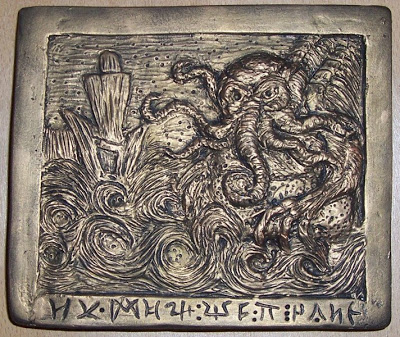
The Call of Cthulhu, in a similar fashion to Pickman’s Model, presents artistic creation as being in relation with the demonic and otherworldly. Physical evidence of accounts, mostly in the forms of letters and correspondence, are repeated framing devices in many of Lovecraft’s tales and occurs here to create a sense of ‘weird reality’ surrounding the fictitiousness of the tale. The implication of death for any in possession of such knowledge extends through the fictive layer of the story itself as metafiction, and projects upon the voyeuristic eyes of the reader. For likewise, having glimpsed the weird reality of the universe, shown by other Lovecraft short stories, such as Pickman’ Model, to be maddening. Harrington offers an interesting assessment of thalassophobia, the fear of the unknown depths of the sea, embodied by Cthulhu. This fear of the unknown permeates a gap in knowledge and visual acuity as a void (27). The figure of which is shrunk and made corporeal by the representational bas-relief, and sculptures made by Wilcox in the section ‘The Horror in Clay’. His source of creativity is housed in the vividity of his ‘dream[s] of great Cyclopean cities of Titan blocks and sky-flung monoliths’ (205). Furthermore, the sculptor’s ‘imagination had been keenly affected’ by the strange goings on across the globe, as if exerting a form of hyper-sensitivity and awareness (Ibid). The bas-relief also inscribed with hieroglyphs shows the same ‘vagaries of cubism and futurism’ as the sculptures (204). This weird art proposes ‘cracks’ that ‘appear in the glossy varnish of the ordinary, leaving the field open for troublesome hypotheses’ (Houellebecq, 51). The troublesome outcome being the paralysis of language; a form of purposeful ‘catachresis’, extended from Harman’s examination of the gaps between the real objects and our experience of them (Kneale, 46). If language is futile and resistant of true representation, alongside the likes of the visual and auditory arts, then what evolves in its place? The artistic object created in Cthulhu proposes a new model of communication, that takes creation from the pure idealism of the perceived, and makes it manifest in the physical world. Kneale has further explored this mode of ‘media’ and object potential as housing deeper meaning; ‘the material artefacts found in weird fiction, like the Cthulhu bas-relief, are similarly mysterious bearers of meaning’ that cannot be unravelled (53). The critic goes on to link these objects to forms of communication, that mediate between and across time. However, whilst these objects impose a sense of the beyond, they are not themselves the gates to the transcendent other; only indirect allusions and copies of a true form. In this sense, the artist is a conduit for other beings to establish their ‘thing-power’. Always ‘exceeding representation, the nameless Thing escapes limits disclosing only the unending outside’, which is forever beyond the limits of perception (Van Elferen, 89). Though creatures from beyond, such as Cthulhu, attempt to break through into this reality, they are forever removed by their perceived qualities and the strange materiality of this realm.

The viol in The Music of Eric Zann is presented as an object in communication with the beyond. The ‘hyper-cacophony’ of music and sound in Lovecraft noted by Van Elferen, also reaches into notions of hyper-sensitivity to the point of sense-dissolution. The narrator recalls his experiences as a tenant in a housing block, and mysteriously faulters to remember where the building was ever situated after the penultimate night of music. Zann’s music playing is associated with the ‘nocturnal’, as ‘sounds which filled me with indefinable dread’, and ‘vibrations suggesting nothing on this globe of earth’ (61). This ‘suggesting’ is merely a speculation of the music’s source, for the true creator is never found. It is his ‘shrieking viol’ that emits the sounds of shrill terror, and is the object that houses the artistic framing of this tale. Lovecraft makes the calm and melodic beauty of the viol sinister yet still enchanting. The degree to which this enchanting ability might be related to magic is unknown, but in a world of gaps- anything can fill the space of the imagination.

The framing of perception in Lovecraft situates humans as subject and object paradoxically. The Outsider proposes a difference of perspective from the layering narratives of other stories that are transcribed by various letters and framing devices. This short story shifts toward a claustrophobic, introspective narrative. The narrator mourns over lost childhood years: ‘Unhappy is he to whom the memories of childhood bring only fear and sadness (141). As a voice in third person, there is a sense of a distanced ‘he’ and yet simultaneously the narrator aims this sorrow as if at himself. His sulking and exploring around the setting of the castle culminates in a frightful revelation about his sense of self. This unveiling occurs through the framing object of a mirror that reveals a tear between subject and object conceptualisation of the self. For he says, ‘my fingers touched the rotting outstretched paw of the monster beneath the golden arch’, thinking it some otherworldly monster (146). However, to his horror this ‘paw’ is revealed to be ‘a cold and unyielding surface of polished glass’; a reflection of his own misery forced into object status by the ‘gilded frame’ that entraps his form (147). Previously as the onlooker, the perspective is now inverted upon the self, suggesting the monstrosity is an internal rather than of an external threat. The Outsider, in this respect, reveals a different fear to that of Lovecraft’s other tales. Whilst subjects in Lovecraft’s writing often interact with objects, not often do they themselves take the place of the uncanny other. In this instance, the artistic framing of the demonic does not create a portal to the beyond, but rather it reflects on itself the weirdness of reality.

The narrator when describing the blasted heath in The Colour Out of Space makes an inference to the location as being akin to an artistic rendition of the object in question; ‘It was too much like a landscape of Salvator Rosa; too much like a forbidden woodcut in a tale of horror’ (167). Ralickas notes that despite the infered creative genius of the landscape, ‘the land surveyor […] takes no pleasure in observing the infinite expanse of the night sky’ (297). Instead he is horrified and struck by what he is told, leaving behind any ‘aesthetic judgment’ as secondary to fear (Ibid). This narration is layered through the storytelling of Ammi and the relaying of this dreaded tale to the reader by a worker from the city on location to build a new reservoir over the deserted space. The landscape takes on the erosive qualities of the meteorite by a mode of unknown transference. In the end, the mechanism behind the chaos is never discovered, nor the reason for the disaster ever revealed, despite the efforts of Arkham scientists to make sense of this object. Whatever truth the meteorite holds can never be revealed as the humans only ever encounter the sensual qualities and not the real object. The sense of focus here being that of visual representation, as a coalescing of colours and qualities ‘almost impossible to describe […] it was only by analogy that they called it colour at all’ (171). Despite the object’s seeming impossibility, it remains as existing in a liminal state ‘almost impossible’ but still retaining enough qualities to be referred to by ‘analogy’ as a series of impressions and hues. For ‘objects cannot just be lists of assorted qualities, but must have some organising principle linking them together in a specific way’, in relation to the meteorite the principle is that of its visual essence (Harman, Towards Speculative Realism, 149). Lovecraft even describes the object’s seeming ‘brittleness and hollowness’, as made of material, as well as metaphysical, gaps in understanding (Ibid). The unknown material of the meteorite unable to stay in a definable form disappears, for ‘no residue was left behind’ (172). Yet the narrator questions the purpose of the thing, and the power it exerted, as a ‘weird message from other universes and other realms of matter, force, and entity’ (Ibid). This speculation suggests a potential outside the limited perception of human experience. But, as language remains bound to allusion, the thought of ‘other realms’ remains merely speculation.

Upon reflection, what comes into questioning is the power and use of language as a representational force. Anytime something is alluded to on paper, a copy is created that mimics the true original enshrined in the borders of its frame. It therefore is also a paradox for a writer such as Lovecraft to speak of the inability of language, and to simultaneously house language as the architecture for his created universe. This striving gap between real and perceived remains a central point of interest, however the author never resolves this conundrum for his audience. Though the aesthetic power of language and art can never translate the true object itself, Lovecraft reveals that these objects can be seen in glimpses, whilst simultaneously concealed in a shroud of vacuity at the border of expression.


Works Cited:


Harman, Graham. Weird Realism: Lovecraft and Philosophy. Zero Books, 2012. Dawson Era: https://www.dawsonera.com/readonline/9781780999074. Date Accessed: 8 Jan. 2019.
—Towards Speculative Realism. Zero Books, 2010.


Harrington, Seán J. “The Depths of Our Experience: Thalassophobia and the Oceanic Horror.” Beasts of the Deep: Sea Creatures and Popular Culture, edited by Jon Hackett and Seán Harrington, Indiana University Press, 2018, pp. 27–40. JSTOR, http://www.jstor.org/stable/j.ctt20krz85.7. Date Accessed: 8 Jan. 2019.


Houellebecq, Michelle. H. P. Lovecraft: Against the World, Against Life. Gollancz, 2008.


Joshi, T. S. H. P. Lovecraft: The Decline of the West. Wildside Press, 1990.


Kneale, James. “‘Ghoulish Dialogues’: H. P. Lovecraft’s Weird Geographies.” The Age of Lovecraft, edited by Carl H. Sederholm and Jeffrey Andrew Weinstock, University of Minnesota Press, 2016, pp. 43–61. JSTOR,
http://www.jstor.org/stable/10.5749/j.ctt1b9x1f3.6. Date Accessed: 8 Jan. 2019.


Lovecraft, H. P. Necronomicon: The Best Weird Tales of H. P. Lovecraft, Gollenz Press, 2008.
—“Notes on Writing Weird Fiction”, The H. P. Lovecraft Archive:
http://www.hplovecraft.com/writings/texts/essays/nwwf.aspx. Date Accessed: 7 Jan. 2018.


Luckhurst, Roger, ‘Introduction’, The Classic Horror Stories: H. P. Lovecraft. Oxford University Press, 2013.


Ralickas, Vivian. “Art, Cosmic Horror, and the Fetishizing Gaze in the Fiction of H. P. Lovecraft.” Journal of the Fantastic in the Arts, vol. 19, no. 3, 2008, pp. 297–316. JSTOR, http://www.jstor.org/stable/24352378. Date Accessed: 8 Jan. 2019.

Sederholm, Carl. “What Screams Are Made Of: Representing Cosmic Fear in H.P. Lovecraft’s ‘Pickman’s Model.’” Journal of the Fantastic in the Arts, vol. 16, no. 4, 2006, pp. 335–349., http://www.jstor.org/stable/43310266. Date Accessed: 8 Jan. 2019.

Van Elferen, Isabella. “Hyper-Cacophony: Lovecraft, Speculative Realism, and Sonic Materialism.” The Age of Lovecraft, edited by Carl H. Sederholm and Jeffrey Andrew Weinstock, University of Minnesota Press, 2016, pp. 79–96. JSTOR, http://www.jstor.org/stable/10.5749/j.ctt1b9x1f3.8. Date Accessed: 8 Jan. 2019.


Weinstock, Jeffrey Andrew. “Lovecraft’s Things: Sinister Souvenirs from Other Worlds.” The Age of Lovecraft, edited by Jeffrey Andrew Weinstock and Carl H. Sederholm, University of Minnesota Press, 2016, pp. 62–78. JSTOR, http://www.jstor.org/stable/10.5749/j.ctt1b9x1f3.7. Date Accessed: 8 Jan. 2019


Works Consulted:


Freeman, Nick. “Weird Realism”, Textual Practice, vol. 31, issue. 6, 2017, pp. 1117-1132, TandF Online, DOI: 10.1080/0950236X.2017.1358691. Date Accessed: 8 Jan. 2019.

Harman, Graham. Speculative Realism: An Introduction. Polity Press, 2018. ProQuest Ebook Central: https://ebookcentral.proquest.com/lib/exeter/detail.action?docID=5521182.
Date Accessed: 8 Jan. 2019.


Joshi, S. T. H. P. Lovecraft: Four Decades of Criticism. Ohio University Press, 1980.
—I Am Providence: The Life and Times of H. P. Lovecraft: Vol 2. Hippocampus Press, 2013.


Poole, W. Scott. “Lovecraft, Witch Cults, and Philosophers.” The Age of Lovecraft, edited by Carl H. Sederholm and Jeffrey Andrew Weinstock, University of Minnesota Press, 2016, pp. 215–230. JSTOR, http://www.jstor.org/stable/10.5749/j.ctt1b9x1f3.16. Date Accessed: 7 Jan. 2019.


Sperling, Ali. “H. P. Lovecraft’s Weird Body”, Rhizomes: Cultural Studies in Emerging Knowledge, Issue. 31, 2017, pp.1-17, Rhizomes:
https://doi.org/10.20415/rhiz/031.e09. Date Accessed: 8 Jan 2019.

Thacker, Eugene. Tentacles Longer Than Night: Horror of Philosophy Vol. 3. Zero Books, Dawson Era: https://www.dawsonera.com/readonline/9781782798880. Date Accessed: 8 Jan. 2019.

Beginnings-

As far as we can discern, the sole purpose of human existence is to kindle a light of meaning in the darkness of mere being. – C. G. Jung.

Having recently graduated from an undergraduate degree in English Literature, I wanted to continue writing and discussing art in my own time. My goal is to use this space to share my ideas, thoughts, and musings with regards to interdisciplinary topics in the format of written essays or brief articles.

My primary interests include:

  • Art, literature and music
  • Gothic and macabre
  • Science- neuroscience and medicine
  • Medical history
  • Philosophy and studies of consciousness
  • Mental health
  • Psychology- behavioural, symbolic, and artistic archetypes.

Create a website or blog at WordPress.com

Up ↑

Design a site like this with WordPress.com
Get started