
In Lovecraft’s Notes on Writing Weird Fiction, he admits:
‘My reason for writing stories is to give myself the satisfaction of visualising more clearly and detailedly and stably the vague, elusive, fragmentary impressions of wonder, beauty, and adventurous expectancy which are conveyed to me by certain sights […] one of my strongest and most persistent wishes being to achieve, momentarily, the illusion of some strange suspension or violation of the galling limitations of time, space, and natural law which for ever imprison us and frustrate our curiosity about the infinite cosmic spaces beyond the radius of our sight and analysis.’
The H. P. Lovecraft Archive
Lovecraft highlights here the desire to ‘clearly and detailedly’ create an image of something that is simultaneously ‘elusive’, ‘fragmentary’, and made of many separate ‘impressions’ (Ibid). Like an artist painting a scene, he provides an ‘illusion’ of, or allusion to, an image. However, these separate pieces of the object, amalgamated and informed by language, can never truly capture the actuality of the thing itself. This incomprehension of truth remains throughout Lovecraft’s work, and in his philosophy, as a structural base. Within the ever-expanding branch of philosophy termed ‘Speculative Realism’, such discussions of the artistic framing of these gaps in perception has been overlooked. Lovecraft’s narratives often contain objects that imply a revealing of the otherworldly, and yet, upon reflection, defy the truth hidden beneath them. These portal-like objects however ultimately fail to transport readers to a beyond, as they remain dismantled pieces of an unattainable whole. Their real otherness to be forever hidden behind the implication of their sensual qualities, relayed by the use of language as theorised by Harman’s foundational work on the ‘gap between reality and its accessibility to us’ (Weird Realism, 29). Although every Lovecraft tale contains plenty of weird objects to investigate, for the purpose of this essay, analysis shall make reference to: the viol in The Music of Eric Zann (1922), the mirror in The Outsider (1926), the meteorite in The Colour Out of Space (1927), the clay bas-relief in The Call of Cthulhu (1928), and the penultimate framed painting in Pickman’s Model (1927). This essay will examine how perception in Lovecraft’s writing is limited through the use, and framing, of objects. These sensual objects are alluded to in great detail, but remain untranslatable as real objects. What takes their place is the visual quality of their being. Rather than acting as ‘portals to’ other worlds, as critics such as Weinstock have argued, these objects instead stand in defiance of what the otherworldly embodies; as beyond language and comprehension (68).
Joshi in his 1990 extended Lovecraft essay The Decline of the West, provides an early attempt at analysing the philosophical aspects of the Weird fiction writer’s work. Therein Joshi subdivides the most prominent features of his philosophy into: metaphysics, ethics, aesthetics, and politics. Although less defined and focused than latter critical approaches to Lovecraftian philosophy, Joshi opens the portal for others to begin thinking of Lovecraft in terms of his weird fiction genre, one that is an ‘inherently philosophical mode in that it forces the reader to confront directly such issues as the nature of the universe and mankind’s place in it’ (III). Despite Lovecraft’s perspective of ‘cosmic indifferentism’ regarding human and universe relations, his stories still require the first-hand experience of individual humans even if, in themselves, these characters become archetypally fated to destruction (Luckhurst, XXII). This reliance upon first person experience and perspective implies a certain level of reality that must exist separate to a merely nihilistic framework, but not one that suggests a complete radical transference to idealism either. Here comes into play Harman’s ‘Object-Orientated Ontology’, that proposes the most effective model of analysing Lovecraft’s work, when compared with the other original tenants of ‘Speculative Realism’. Harman’s theories offer a middle-ground between the radical nihilism of Brassier’s philosophy, and the egocentric idealism of Grant’s ‘Neovitalism’ that both insist upon polarising viewpoints of ontology. In creation of the ‘Weird Realism’ genre placed at the crux of Lovecraftian horror, Harman’s juxtaposing of the ‘real’ with the ‘weird’ encompasses one of the core paradoxical tenants of Lovecraft’s philosophical leanings (Weird Realism, 46-47). Central to this discussion of real and sensual objects is Harman’s OOO theory of gaps between the object that we are in sensual contact with, and the real object that lies beyond our perceptive ability.

More recent studies of ‘Speculative Realism’ still rely much upon Harman’s work, as exemplified by Kneale and Van Elferen’s essays, among many others. During Kneale’s reviewing and reiteration of Harman’s OOO principles, the critic highlights how through this perspective ‘Lovecraft’s style encourages readers to create what are, in effect, new objects’ (49). The gap between reality and the perceived is therefore opened as a space for further creation to be made, as the reader themselves becomes implicit in new artistic acts of creation. Other critics have also focused on the role of art in Lovecraft’s storytelling. Van Elferen’s essay provides a basis for discussions of artistic disharmony, focusing upon the sensual quality of sound and music (79). Her analysis can be further extended into the world of artistic objects and the visual senses created through language. The shift in perceptions of Lovecraft himself, from being a pulp fiction writer, to being recognised as a main canonical writer of horror, even having his major works printed as an Oxford edition in 2013. As an ever-growing field of philosophical debate, it seems most important to discuss the role of art and ‘Speculative Realism’ in Lovecraft’s work. That, despite the efforts of art to reveal truths about the universe and human experience, in Lovecraft’s writing he manages to ultimately evade such presentation through these aesthetic gaps. Artistic revelation causes death or madness rather than transcendence, and subverts the idealised, creative spirit that destroys by creating.

Weinstock’s essay on the sinister objects from Lovecraft’s world reinstates the reasoning for their status as horrifying and uncanny: ‘The milieu of the Gothic narrative is one of animate objects- of things that acquire mystery, depth, and often life of some sort- and of de-animated subjects, people who are treated like or become things’ (63). The boundaries between objects and their means of being perceived are therefore shifted to a place of ambiguity. Objects attain a sense of agency and power, but remain to be elusive and mysterious. The use of aesthetic objects in Gothic fiction occurs elsewhere in Wilde’s The Picture of Dorian Gray (1890), and M. R. James’ numerous tales of human and object interactions such as The Mezzotint (1904) with both sharing many overlapping qualities with the living canvas of Pickman’s Model. Though these tales seem to reveal a hidden truth, the actual mechanism and reality of their meaning remains elusive. As proposed by Harman, the gap between an object’s ‘sensual qualities’ and ‘real’ qualities is extended through Lovecraft’s language of indirection and vacuity. This vacuity can be examined at the level of objects whose inherent role is to traditionally depict matters of revelation. This revelation is found in the form of art, mirrors, and their frames. Van Elferen in her analysis of musicology and Lovecraftian fiction notes how aesthetic experiences in themselves are conceptual and abstracted from the materialism inherent in the philosophy of ‘Speculative Realism’. She marks how the ‘immaterial’ and ‘metaphysical components’ of Lovecraft’s tales are often ignored in place of purely materialist philosophies (91). Though this seems to propose a limitation of this field, I would suggest that the pure materialism of some speculative realist critics can be resolved by means of intermediation. The aesthetic experience of objects and their sensual qualities may therefore account for the gaps between the reality of the object and what is expressed, as a form of suspension or horrifying awe.
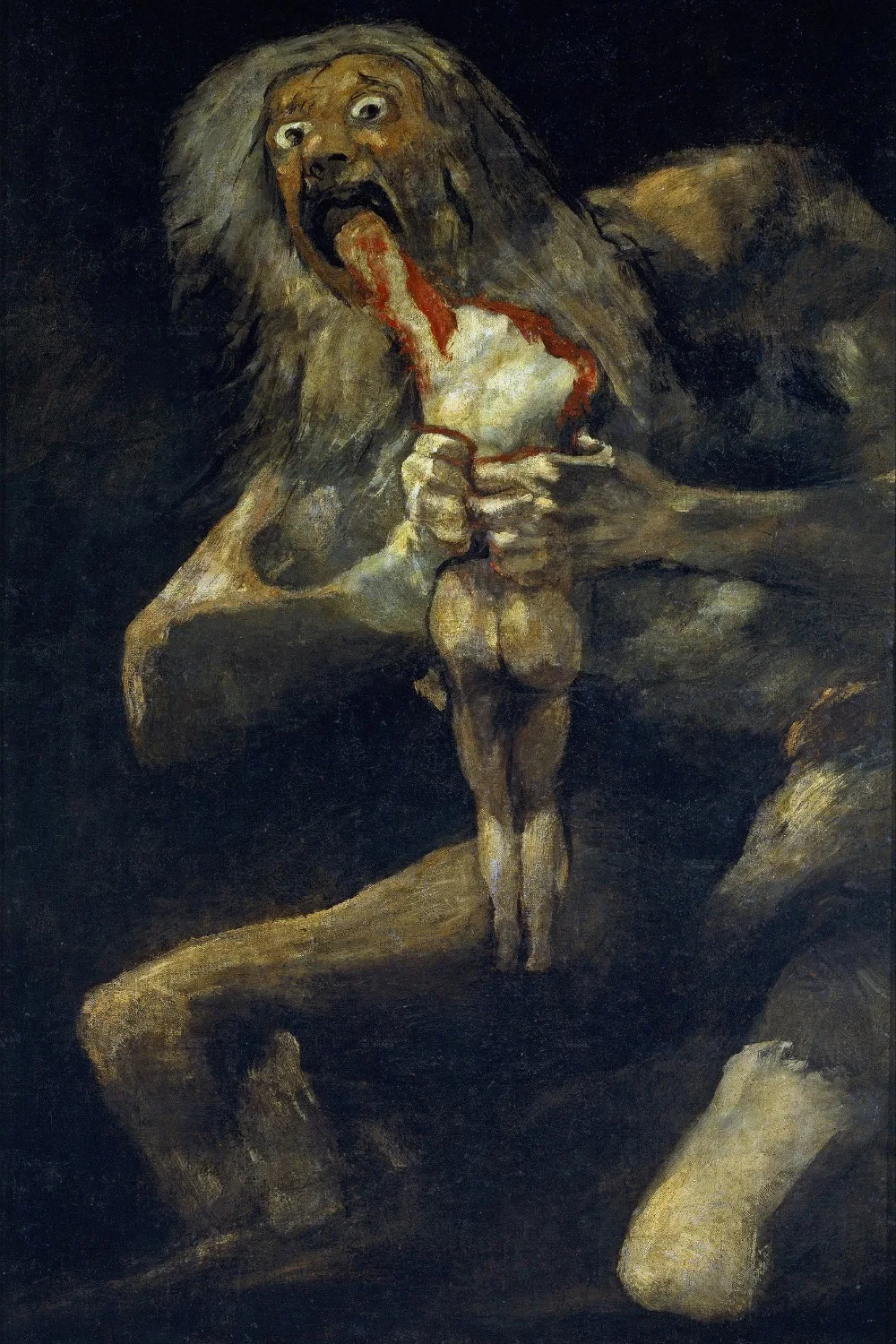
This suspension of the real is found in the art frames of Pickman’s Model. Here the demonic and otherworldly is presented as being literally infused into the artwork, culminating in the final piece as a live copy of the real ‘model’ object in sight. Thurber recounts, ‘As I am a living being, I never elsewhere saw the actual breath of life so fused into the canvas’ (198). The artist ‘wasn’t strictly human’; the implication being that his consultations with the demonic have exerted a powerful sway over his mental wellbeing and sent him into a manic state of inspiration not wholly his own (199). The narrator reflects upon his reaction to these perversions of aesthetic experience as powerful ‘things [that] repelled because of the utter inhumanity and callous cruelty they showed in Pickman’ as mirrors to the shadow self (196). The object is able to transfer a fear of association outward from its source, bringing into question the artist’s sanity to create such presentations. However, the true horror arises not from the sight of the creature’s double or the rendering of it, but rather the revelation that there is a real being beyond the bounds of the frame that exists, for ‘that paper wasn’t a photograph of any background […] it was a photograph from life’ (200). Upon reflection, the tale reinstates ‘the power of the photograph to reconfigure one’s sense of reality’ (Weinstock, 74). Sederholm surmises that ‘the end result […] is an anxious understanding that weird art transforms the overall sanity of man’, an understanding that arguably comes too late for Pickman (344-345). Furthermore, this ‘thing-power’ not only reconfigures the individual’s sense of reality, but also starts to interrogate the reality of other beings as well, widening the scope of potential existence to the otherworldly and demonic.
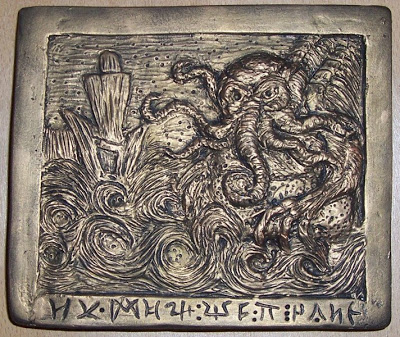
The Call of Cthulhu, in a similar fashion to Pickman’s Model, presents artistic creation as being in relation with the demonic and otherworldly. Physical evidence of accounts, mostly in the forms of letters and correspondence, are repeated framing devices in many of Lovecraft’s tales and occurs here to create a sense of ‘weird reality’ surrounding the fictitiousness of the tale. The implication of death for any in possession of such knowledge extends through the fictive layer of the story itself as metafiction, and projects upon the voyeuristic eyes of the reader. For likewise, having glimpsed the weird reality of the universe, shown by other Lovecraft short stories, such as Pickman’ Model, to be maddening. Harrington offers an interesting assessment of thalassophobia, the fear of the unknown depths of the sea, embodied by Cthulhu. This fear of the unknown permeates a gap in knowledge and visual acuity as a void (27). The figure of which is shrunk and made corporeal by the representational bas-relief, and sculptures made by Wilcox in the section ‘The Horror in Clay’. His source of creativity is housed in the vividity of his ‘dream[s] of great Cyclopean cities of Titan blocks and sky-flung monoliths’ (205). Furthermore, the sculptor’s ‘imagination had been keenly affected’ by the strange goings on across the globe, as if exerting a form of hyper-sensitivity and awareness (Ibid). The bas-relief also inscribed with hieroglyphs shows the same ‘vagaries of cubism and futurism’ as the sculptures (204). This weird art proposes ‘cracks’ that ‘appear in the glossy varnish of the ordinary, leaving the field open for troublesome hypotheses’ (Houellebecq, 51). The troublesome outcome being the paralysis of language; a form of purposeful ‘catachresis’, extended from Harman’s examination of the gaps between the real objects and our experience of them (Kneale, 46). If language is futile and resistant of true representation, alongside the likes of the visual and auditory arts, then what evolves in its place? The artistic object created in Cthulhu proposes a new model of communication, that takes creation from the pure idealism of the perceived, and makes it manifest in the physical world. Kneale has further explored this mode of ‘media’ and object potential as housing deeper meaning; ‘the material artefacts found in weird fiction, like the Cthulhu bas-relief, are similarly mysterious bearers of meaning’ that cannot be unravelled (53). The critic goes on to link these objects to forms of communication, that mediate between and across time. However, whilst these objects impose a sense of the beyond, they are not themselves the gates to the transcendent other; only indirect allusions and copies of a true form. In this sense, the artist is a conduit for other beings to establish their ‘thing-power’. Always ‘exceeding representation, the nameless Thing escapes limits disclosing only the unending outside’, which is forever beyond the limits of perception (Van Elferen, 89). Though creatures from beyond, such as Cthulhu, attempt to break through into this reality, they are forever removed by their perceived qualities and the strange materiality of this realm.

The viol in The Music of Eric Zann is presented as an object in communication with the beyond. The ‘hyper-cacophony’ of music and sound in Lovecraft noted by Van Elferen, also reaches into notions of hyper-sensitivity to the point of sense-dissolution. The narrator recalls his experiences as a tenant in a housing block, and mysteriously faulters to remember where the building was ever situated after the penultimate night of music. Zann’s music playing is associated with the ‘nocturnal’, as ‘sounds which filled me with indefinable dread’, and ‘vibrations suggesting nothing on this globe of earth’ (61). This ‘suggesting’ is merely a speculation of the music’s source, for the true creator is never found. It is his ‘shrieking viol’ that emits the sounds of shrill terror, and is the object that houses the artistic framing of this tale. Lovecraft makes the calm and melodic beauty of the viol sinister yet still enchanting. The degree to which this enchanting ability might be related to magic is unknown, but in a world of gaps- anything can fill the space of the imagination.

The framing of perception in Lovecraft situates humans as subject and object paradoxically. The Outsider proposes a difference of perspective from the layering narratives of other stories that are transcribed by various letters and framing devices. This short story shifts toward a claustrophobic, introspective narrative. The narrator mourns over lost childhood years: ‘Unhappy is he to whom the memories of childhood bring only fear and sadness (141). As a voice in third person, there is a sense of a distanced ‘he’ and yet simultaneously the narrator aims this sorrow as if at himself. His sulking and exploring around the setting of the castle culminates in a frightful revelation about his sense of self. This unveiling occurs through the framing object of a mirror that reveals a tear between subject and object conceptualisation of the self. For he says, ‘my fingers touched the rotting outstretched paw of the monster beneath the golden arch’, thinking it some otherworldly monster (146). However, to his horror this ‘paw’ is revealed to be ‘a cold and unyielding surface of polished glass’; a reflection of his own misery forced into object status by the ‘gilded frame’ that entraps his form (147). Previously as the onlooker, the perspective is now inverted upon the self, suggesting the monstrosity is an internal rather than of an external threat. The Outsider, in this respect, reveals a different fear to that of Lovecraft’s other tales. Whilst subjects in Lovecraft’s writing often interact with objects, not often do they themselves take the place of the uncanny other. In this instance, the artistic framing of the demonic does not create a portal to the beyond, but rather it reflects on itself the weirdness of reality.
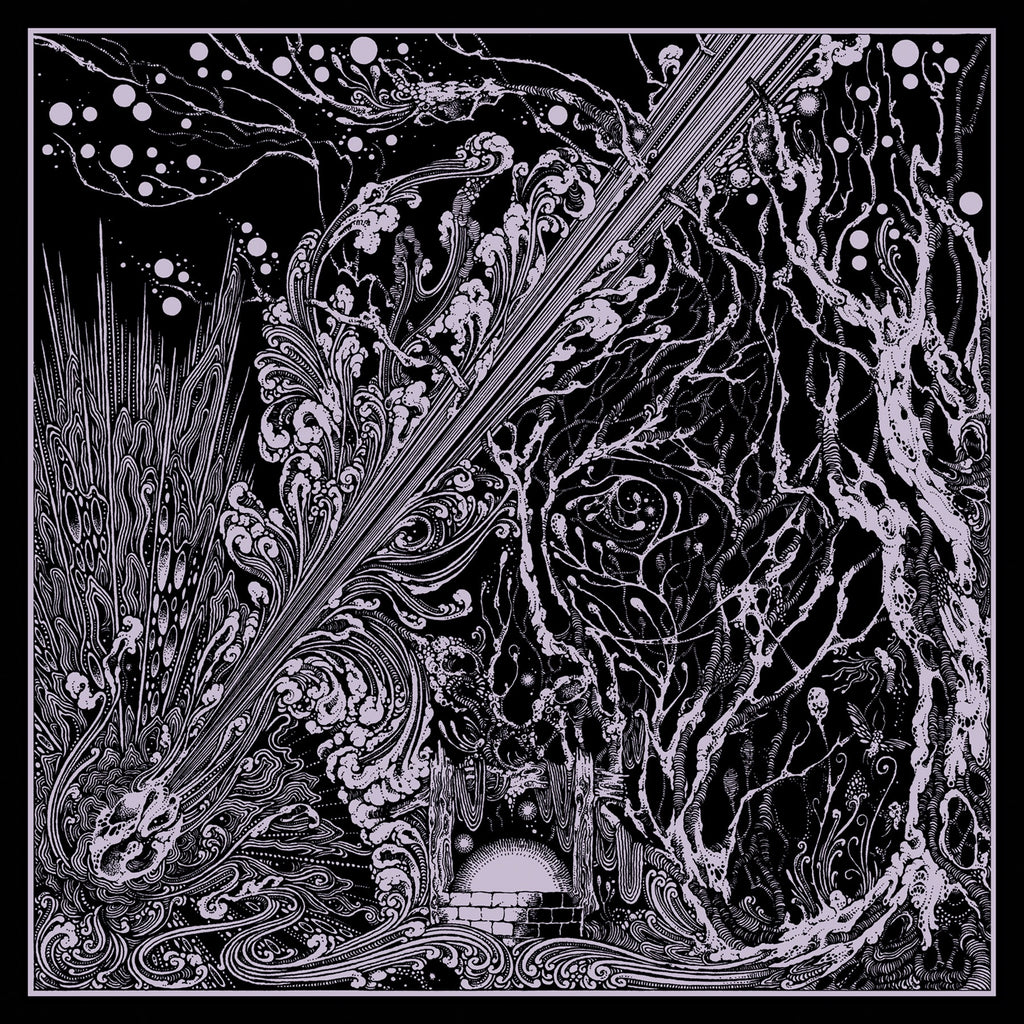
The narrator when describing the blasted heath in The Colour Out of Space makes an inference to the location as being akin to an artistic rendition of the object in question; ‘It was too much like a landscape of Salvator Rosa; too much like a forbidden woodcut in a tale of horror’ (167). Ralickas notes that despite the infered creative genius of the landscape, ‘the land surveyor […] takes no pleasure in observing the infinite expanse of the night sky’ (297). Instead he is horrified and struck by what he is told, leaving behind any ‘aesthetic judgment’ as secondary to fear (Ibid). This narration is layered through the storytelling of Ammi and the relaying of this dreaded tale to the reader by a worker from the city on location to build a new reservoir over the deserted space. The landscape takes on the erosive qualities of the meteorite by a mode of unknown transference. In the end, the mechanism behind the chaos is never discovered, nor the reason for the disaster ever revealed, despite the efforts of Arkham scientists to make sense of this object. Whatever truth the meteorite holds can never be revealed as the humans only ever encounter the sensual qualities and not the real object. The sense of focus here being that of visual representation, as a coalescing of colours and qualities ‘almost impossible to describe […] it was only by analogy that they called it colour at all’ (171). Despite the object’s seeming impossibility, it remains as existing in a liminal state ‘almost impossible’ but still retaining enough qualities to be referred to by ‘analogy’ as a series of impressions and hues. For ‘objects cannot just be lists of assorted qualities, but must have some organising principle linking them together in a specific way’, in relation to the meteorite the principle is that of its visual essence (Harman, Towards Speculative Realism, 149). Lovecraft even describes the object’s seeming ‘brittleness and hollowness’, as made of material, as well as metaphysical, gaps in understanding (Ibid). The unknown material of the meteorite unable to stay in a definable form disappears, for ‘no residue was left behind’ (172). Yet the narrator questions the purpose of the thing, and the power it exerted, as a ‘weird message from other universes and other realms of matter, force, and entity’ (Ibid). This speculation suggests a potential outside the limited perception of human experience. But, as language remains bound to allusion, the thought of ‘other realms’ remains merely speculation.

Upon reflection, what comes into questioning is the power and use of language as a representational force. Anytime something is alluded to on paper, a copy is created that mimics the true original enshrined in the borders of its frame. It therefore is also a paradox for a writer such as Lovecraft to speak of the inability of language, and to simultaneously house language as the architecture for his created universe. This striving gap between real and perceived remains a central point of interest, however the author never resolves this conundrum for his audience. Though the aesthetic power of language and art can never translate the true object itself, Lovecraft reveals that these objects can be seen in glimpses, whilst simultaneously concealed in a shroud of vacuity at the border of expression.
Works Cited:
Harman, Graham. Weird Realism: Lovecraft and Philosophy. Zero Books, 2012. Dawson Era: https://www.dawsonera.com/readonline/9781780999074. Date Accessed: 8 Jan. 2019.
—Towards Speculative Realism. Zero Books, 2010.
Harrington, Seán J. “The Depths of Our Experience: Thalassophobia and the Oceanic Horror.” Beasts of the Deep: Sea Creatures and Popular Culture, edited by Jon Hackett and Seán Harrington, Indiana University Press, 2018, pp. 27–40. JSTOR, http://www.jstor.org/stable/j.ctt20krz85.7. Date Accessed: 8 Jan. 2019.
Houellebecq, Michelle. H. P. Lovecraft: Against the World, Against Life. Gollancz, 2008.
Joshi, T. S. H. P. Lovecraft: The Decline of the West. Wildside Press, 1990.
Kneale, James. “‘Ghoulish Dialogues’: H. P. Lovecraft’s Weird Geographies.” The Age of Lovecraft, edited by Carl H. Sederholm and Jeffrey Andrew Weinstock, University of Minnesota Press, 2016, pp. 43–61. JSTOR,
http://www.jstor.org/stable/10.5749/j.ctt1b9x1f3.6. Date Accessed: 8 Jan. 2019.
Lovecraft, H. P. Necronomicon: The Best Weird Tales of H. P. Lovecraft, Gollenz Press, 2008.
—“Notes on Writing Weird Fiction”, The H. P. Lovecraft Archive:
http://www.hplovecraft.com/writings/texts/essays/nwwf.aspx. Date Accessed: 7 Jan. 2018.
Luckhurst, Roger, ‘Introduction’, The Classic Horror Stories: H. P. Lovecraft. Oxford University Press, 2013.
Ralickas, Vivian. “Art, Cosmic Horror, and the Fetishizing Gaze in the Fiction of H. P. Lovecraft.” Journal of the Fantastic in the Arts, vol. 19, no. 3, 2008, pp. 297–316. JSTOR, http://www.jstor.org/stable/24352378. Date Accessed: 8 Jan. 2019.
Sederholm, Carl. “What Screams Are Made Of: Representing Cosmic Fear in H.P. Lovecraft’s ‘Pickman’s Model.’” Journal of the Fantastic in the Arts, vol. 16, no. 4, 2006, pp. 335–349., http://www.jstor.org/stable/43310266. Date Accessed: 8 Jan. 2019.
Van Elferen, Isabella. “Hyper-Cacophony: Lovecraft, Speculative Realism, and Sonic Materialism.” The Age of Lovecraft, edited by Carl H. Sederholm and Jeffrey Andrew Weinstock, University of Minnesota Press, 2016, pp. 79–96. JSTOR, http://www.jstor.org/stable/10.5749/j.ctt1b9x1f3.8. Date Accessed: 8 Jan. 2019.
Weinstock, Jeffrey Andrew. “Lovecraft’s Things: Sinister Souvenirs from Other Worlds.” The Age of Lovecraft, edited by Jeffrey Andrew Weinstock and Carl H. Sederholm, University of Minnesota Press, 2016, pp. 62–78. JSTOR, http://www.jstor.org/stable/10.5749/j.ctt1b9x1f3.7. Date Accessed: 8 Jan. 2019
Works Consulted:
Freeman, Nick. “Weird Realism”, Textual Practice, vol. 31, issue. 6, 2017, pp. 1117-1132, TandF Online, DOI: 10.1080/0950236X.2017.1358691. Date Accessed: 8 Jan. 2019.
Harman, Graham. Speculative Realism: An Introduction. Polity Press, 2018. ProQuest Ebook Central: https://ebookcentral.proquest.com/lib/exeter/detail.action?docID=5521182.
Date Accessed: 8 Jan. 2019.
Joshi, S. T. H. P. Lovecraft: Four Decades of Criticism. Ohio University Press, 1980.
—I Am Providence: The Life and Times of H. P. Lovecraft: Vol 2. Hippocampus Press, 2013.
Poole, W. Scott. “Lovecraft, Witch Cults, and Philosophers.” The Age of Lovecraft, edited by Carl H. Sederholm and Jeffrey Andrew Weinstock, University of Minnesota Press, 2016, pp. 215–230. JSTOR, http://www.jstor.org/stable/10.5749/j.ctt1b9x1f3.16. Date Accessed: 7 Jan. 2019.
Sperling, Ali. “H. P. Lovecraft’s Weird Body”, Rhizomes: Cultural Studies in Emerging Knowledge, Issue. 31, 2017, pp.1-17, Rhizomes:
https://doi.org/10.20415/rhiz/031.e09. Date Accessed: 8 Jan 2019.
Thacker, Eugene. Tentacles Longer Than Night: Horror of Philosophy Vol. 3. Zero Books, Dawson Era: https://www.dawsonera.com/readonline/9781782798880. Date Accessed: 8 Jan. 2019.
 The Literary Cosmos